

When One Punch Changes Everything

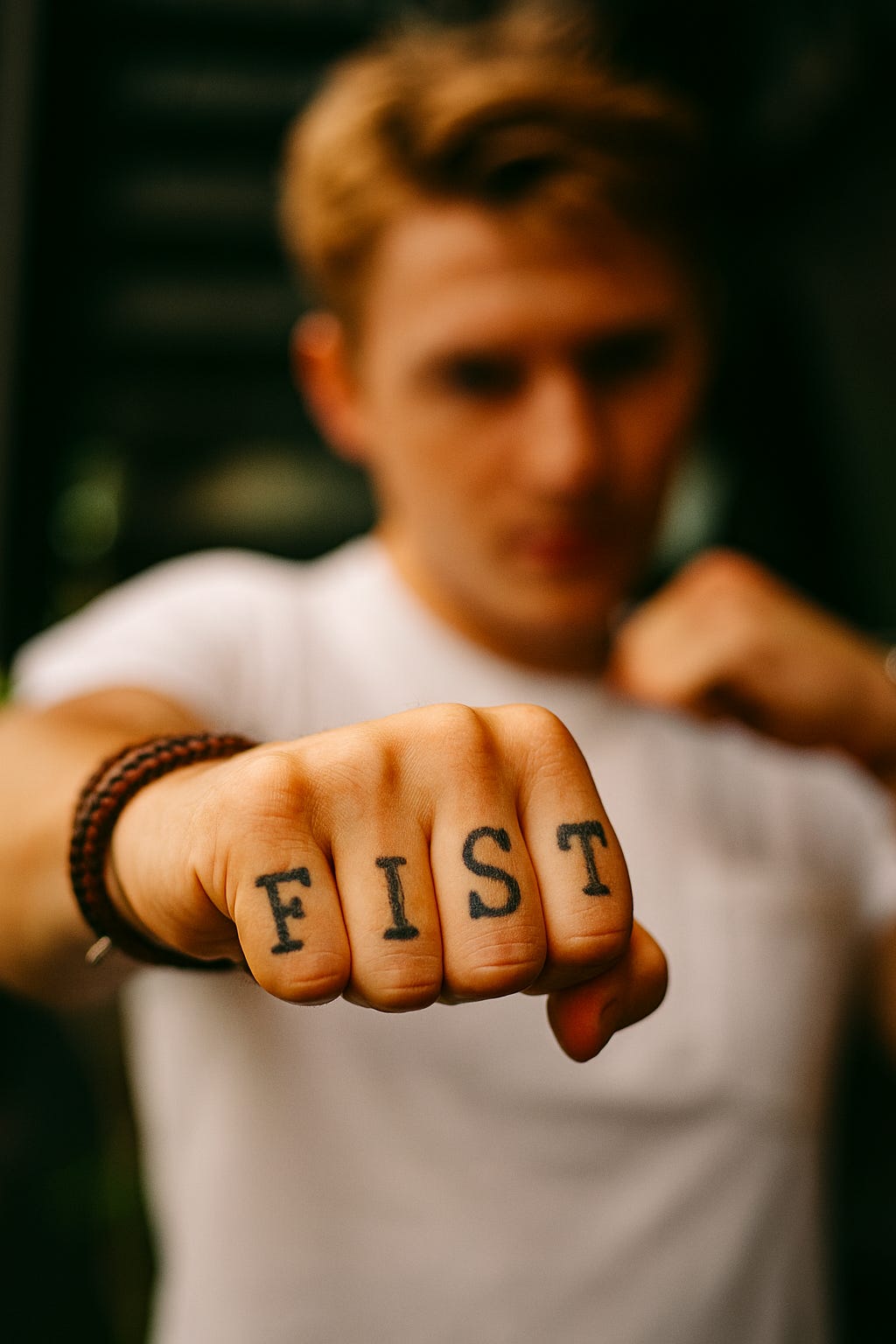
Last Friday night, Belfast.
A place, ironically, called The Holylands - a strange patch in the south of the city, famous for its biblical street names - Palestine, Damascus, Jerusalem - and utterly godless nights. It’s an area both vile and viral: cheap rents, chaotic student parties, bins overflowing with pizza boxes and cider bottles. The population is transient - students chasing the lowest rents. It even has its own Instagram account Holylands Spotted.
It’s the kind of place that hums like an amplifier after dark, every pavement sticky with beer, discarded takeaways, vomit, and anticipation.
I was walking back from an event when I saw them - two young guys, barely steady, squared off under a lamplight halo. They were doing that thing lads do when alcohol meets ego: swaying forward, fists loose, globs of spit caught in the light as swear words exploded from their mouths.
And yet - no contact. Each swing cut through air, sloppy and theatrical, more pantomime than peril. A small crowd hovered around them, some lit phones out, waiting for impact. But none came.
I remember asking myself: is this the shape of our entertainment now - all threat and no hit, all noise and no truth? Still, even in its emptiness, it was powerful and it got me thinking. Because a punch doesn’t have to land to land somewhere.
The Body Behind the Blow
Science tells us that a punch starts in the legs. Power coils through the thighs, twists through the torso, surges into the arm, and releases through the fist - physics meeting physiology. The shockwaves travel back through both bodies: bone, nerve, tissue, synapse.
A punch isn’t just violence; it’s communication at its most primitive. Your nervous system floods with adrenaline, your amygdala fires, your rational mind disappears. You become pure response, pure animal.
And yet, to land that blow, you must cross a threshold - from impulse to action. That crossing is what separates the thought of harm from harm itself.
We talk about “fight or flight,” but forget there’s a third option - to freeze. The two boys I saw in the Holylands were frozen in that limbo, performing the idea of the punch, unwilling to cross the threshold. Maybe they were lucky.
Because when a punch lands, the body of the struck person becomes an echo chamber. The head snaps back; the brain sloshes against its casing. Even one hit can cause concussion. Many cause worse. And then there’s the emotional reverberation: shame, fear, trauma, rage. The body moves on, but the mind keeps replaying the moment.
The Punch as Myth
Irish culture knows the punch better than most - it’s the way men have historically learned to speak when words fail them: fists instead of feelings, muscle instead of mouth. We’ve long been a country that bottles things up until they burst, turning silence into an art form and violence into its vocabulary. But I thought we’d got past all that.
I remember seeing The Quiet Man as a child - John Wayne’s Sean Thornton, the American who comes home to the “Auld Sod,” proving himself not through words but through his fists. That long, dust-filled fight, half brawl and half pantomime, ends in laughter and reconciliation. It’s the Ireland we exported: drink, pride, the pub punch-up that heals instead of harms. The fight as ritual. The punch as release.
We’ve always mythologised the fist - the old language of men who were never taught another. It became the way to say what couldn’t be said aloud: anger, pride, regret, longing, shame. One clean hit, and the feelings spilled out. It was a kind of translation - emotion made visible, pain turned into proof.
But there’s a darker verse in that same song. The fist that claimed to express love or discipline was also the one that punished it. It kept little boys and girls “in order,” delivered by the hands of those who preached compassion and practised control. The violence we romanticised in men was sanctified in schools and sacristies, where the same knuckles that held rosary beads taught children to fear the touch of authority. I thought those days had gone too.
What I saw in the Holylands that night wasn’t mythic. It was empty choreography without conviction - two young fellas acting out the echo of an old script, swinging at ghosts of meaning. The gestures had survived, but the purpose hadn’t. The punch lives on, but maybe it’s forgotten what it was for.
And here’s the contradiction I can’t shake. I want to believe that today’s young people are more in touch with their emotions - that they’ve learned to talk, to name what hurts, to process rather than suppress. And many have. Yet walk through a city on a Friday night, or type “punch” into Google News, or scroll through TikTok, and the old performance plays on.
Now the punch isn’t just emotional release - it’s clickbait content. Anger and hurt and humiliation, filmed and shared. Masculinity (primarily but not exclusively) performed for the camera, replayed for clicks and giggles. And some of it is turned against those women who need manners put on them for squaring up to the guys.
What was once an in-the-moment cry of frustration is now a clip that circulates until it loses even that small scrap of feeling. The same old impulse - to show, not say; to hit, not feel - has simply found a new stage. The punch survives not because it still means something, but because it still gets attention.
It’s both modern and ancient at once: emotion replaced by exhibition, vulnerability turned into spectacle. And the more we film it, the less we seem to feel it.
The Punch on Screen
I can only speak about my experience but cinema has always known that the punch isn’t just about violence - it’s about emotion. Film gave it a context; it showed me how feeling becomes force when there’s no safer outlet.
The Quiet Man (1952), as I mentioned, began the conversation: John Ford’s lush, sentimental Ireland, where Wayne’s fists bridge the gap between pride and belonging.
Half a century later, The Boxer (1997) - Jim Sheridan’s careful, humane drama - stripped away the romance. Daniel Day-Lewis plays a Belfast IRA man carrying both political trauma and personal loss, and boxing becomes the only place he’s allowed to feel. His fists are the way he processes everything else.
And, being Day-Lewis, he didn’t just act the part. Under the guidance of former world boxing champion, and local hero, Barry McGuigan, he trained and sparred for nearly three years. McGuigan said Day-Lewis could have fought professionally. Every movement in that film feels crafted, deliberate, almost meditative - violence turned into control, grief made physical.
Then I saw Knuckle (2011), where control goes out the window. It’s raw and unsparing - a documentary following Irish Traveller families through their generations-long bare-knuckle feuds. Here, the punch is inheritance, a way of expressing loyalty, defiance, masculinity. Fists as family tradition. It’s communication through combat, emotion passed down like an heirloom.
I didn’t see Snatch (2000) when it first came out, but I remember the reviews of Brad Pitt’s accent. I watched it after seeing Knuckle and Guy Ritchie’s chaotic but knowing comedy of gangs and gamblers was more in the Quiet Man territory of punch as performance and pantomime. Pitt’s Mickey, the “pikey” boxer, fights with an unpredictable beauty - his body a contradiction: wild yet precise, violence turned choreography. It’s not about emotion anymore; it’s about style, swagger, a fight with nothing at stake but image.
From Ford’s soft nostalgia to Ritchie’s sharp-edged irony, the Irish punch has shifted from something sincere to something self-aware, from a private release to a public performance. Each film mirrors its moment: The Quiet Man’s sentimental pride, The Boxer’s weary hope, Knuckle’s unvarnished realism, Snatch’s knowing swagger.
Threaded through them all runs the same pulse - the punch as the place where feeling goes when there’s nowhere else to put it. Always seductive, never innocent: the fist is raised not only in anger, but in longing and in the desperate need to feel something.
Perhaps, too, there’s a faint mercy in it - that in a country where fists are easier to find than firearms, a punch can still be the blunt alternative to something far worse. Thank God, at least, that our weapons are mostly made of flesh.
The Punch as Tragedy: Jacob Dunne and James Graham
Fuelled by what I’d seen on Friday, I read the reviews of James Graham’s new play Punch at the Nottingham Playhouse. Graham has a reputation for moral complexity. He found his subject in the real-life story of Jacob Dunne, a teenager who threw a single punch on a night out - one blow that killed a man, James Hodkinson.
Just one.
The simplicity of that is devastating - a single swing, thoughtless, split-second, that ended one life and derailed another. Dunne served 30 months in prison. When he was released, the victim’s parents asked to meet him. Through restorative justice - conversations between Dunne and the Hodkinson family - came something strange and human: not forgiveness exactly, but recognition. A tiny bridge built across the chasm of violence.
And isn’t that the true anatomy of a punch? It begins with muscle and momentum, but its echo reverberates through families, courtrooms, headlines, hospital wards. The act is instant; the consequences are lifelong.
From everything I’ve read, Punch forces its audiences to sit with that duality - the way something so basic, so bodily, can be both meaningless and momentous.
The Punch As Nothing
Type “punch” into Google News. I did.
What comes up is an endless litany - headlines that blur into one another, like bruises on the same body:
- Lincoln boxer jailed after killing man with a single punch.
- Belfast: woman knocked unconscious in city centre assault.
- Man punched by cyclist in road rage attack.
- Senior detective warns of rising ‘one-punch’ deaths.
There are dozens more. Hundreds, if you keep scrolling. Each story is told the same way, with the same flat vocabulary of harm.
The police statements are numb with repetition: “one suspect wearing dark trousers and shoes.”
The medical language is stripped bare: head injury, cut lip, concussion.
No colour, no feeling - just the administrative aftershock of violence.
And the pattern is everywhere. Not a Belfast problem. Not a Nottingham problem. Not even an Irish or British one. It’s human - and it’s exhausting.
We’ve normalised the casual punch. We scroll past it as though it were weather. The names change, the night changes, the street changes - but the story stays the same.
Every one of those punches is a failure of imagination - a failure to pause, to name the hurt before it finds its target. The inability to think beyond the next second of rage.
And the most haunting part? How ordinary it’s become.
The Punch as Patriarchy
Just a few weeks ago, a story from The Irish Times caught my attention. Cat O’Driscoll, a councillor and women’s safety advocate, was walking down Dorset Street in Dublin at rush hour when a man she didn’t know punched her in the head. No warning. No words. Just a blow as he passed - her glasses flying, her hair dragged through his fingers.
“He hit me as he passed,” she said. And then he kept on walking.
Even though the street was busy with commuters, not one person stopped to help. A woman in a car rolled down her window to tell O’Driscoll to call the Gardaí - then drove on when the lights changed. That, somehow, feels as shocking as the punch itself: the ordinariness of it, the way a woman could be struck in public and absorbed into the background noise of the city.
When did that become thinkable? Since when did men forget the old taboo - never to strike the smaller, the weaker, the unarmed?
A woman punched to the ground isn’t just another assault; it’s the collapse of an ethical code. It’s the final shrug of a culture that still confuses domination with power, aggression with authority.
If The Quiet Man once romanticised the punch as a man’s inheritance, this new reality shows its corrosion. The old scripts are gone, and chaos has replaced them - men lashing out, seemingly at random, at whoever happens to cross their path.
And now the blows land in broad daylight, in full view of witnesses who look away. Afraid, perhaps. Desensitised, more likely. Or simply uncertain what help looks like anymore.
Violence against women has always been there. But what chills about this latest story is its arbitrariness - that it could happen to a woman whose work is literally about making her city safer. O’Driscoll’s assault feels emblematic of something larger: how thin the line still is between visibility and vulnerability, between being seen and being targeted.
We call such moments “random attacks,” as though randomness excuses them. But there’s nothing random about a culture that allows this. The punch has changed shape again - from private performance to public disregard. And in the silence that follows, another violence takes hold: the violence of indifference.
The Punch as Discipline: Katie Taylor
And yet, in Ireland, the punch can be something else entirely.
Katie Taylor, Ireland’s quiet phenomenon - Olympic gold medallist, undisputed champion, a rare athlete who seems both utterly ordinary and transcendent - stands as proof that force can be transformed. The same movement that once silenced emotion can now express it; the same gesture that wounded can also heal.
Taylor’s punches aren’t about rage. They’re about control - a conversation between body and mind. The same muscles, the same physics, but governed by intention instead of impulse. Every movement is measured. Every strike shaped by thought as much as by training.
In Taylor, the punch finds its higher register. She has reclaimed it from chaos - from pub doors, backstreets, and TikTok clips - and turned it back into a vocabulary of grace, precision, and power held in balance. It isn’t about asserting yourself over anyone, but mastering yourself completely. That’s her revolution: proof that power doesn’t have to shout, or bruise, to be felt.
Taylor stands in the ring with a composure that borders on meditative. Stripped of its noise and ego, the punch is reclaimed as discipline. When her strength is guided by her grace, it becomes something else entirely.
Still, the punch exposes the limits of our language. No matter how it’s dressed - in cinema, in sport, or in the split-second fury of a city street - it always asks the same question: what do we do with the power we have?
Maybe that’s why it’s hard to look away, but also hard to intervene. The punch is human frailty made visible - the split second where instinct outruns reason, or where mastery redeems it. It’s the moment we see what we really are: capable of grace and destruction in the same breath.
The Punch Unthrown
I’ve spent the weekend thinking about those two boys in the Holylands last Friday night. The lamplight, the dark, sour air, the brief stillness between them. One was shouting something slurred; the other taunted; the lights from the smartphones flickered while the small crowd jeered. Arms like windmills, fists flailing. Then, anticlimax - they both staggered off. No blood. No ambulance. No headline. Phew.
Maybe they’ll never know how close they came to becoming another Google News “punch.” But I hope, somewhere deep in their bones, they felt it - that instant of awareness before contact, when both still had a choice.
That’s the threshold of a punch: not the hit, but the hesitation. The moment you decide not to. Because the real power lies not in the fist, but in what you do with it once you know how much damage it can do.
Great piece Clare. The 'need to feel something' made me think of Fight Club. I'm pretty sure that is the basis of most 'fisticuffs'.
Shocking what happened to the women's safety advocate.
I think movie punches inure people to the actual danger. I remember a man being killed on the street by a single punch in a usually quiet town near me a few years ago, and the young man who punched him (whose future was ruined) surprised that that one punch had proved fatal.
Thought-provoking essay, thanks, Claire.